
A B2B application for product configuration and sales support, developed for Aluplast. It is a system that must reflect the complex logic of the products whilst remaining user-friendly for non-technical users.

About the company
Aluplast is a leading manufacturer of window and door systems, combining modern design with advanced technology. They offer a variety of solutions that are characterized by high quality, energy efficiency and aesthetics. The company has a wide distribution network in many countries, on every continent.
Problem
Joinery sales rely on slow, manual pricing, which generates technical errors and ties the distributor to the manufacturer's office hours. This translates into lost sales opportunities and dramatically longer customer decision times.
Solution
Aluapp enables distributors to prepare quotes independently, anytime and anywhere. At the same time, the manufacturer brings order to sales across the entire distribution network. The system automatically enforces technical rules, reducing the time needed to prepare an accurate quote to just a few minutes and bringing the risk of errors practically down to zero.
My role
Lead Product Designer, Product Strategy & Discovery
Delivery
2024 – present
Scope of work
UX Design
UI Design
Wireframe
Design system
AI
Figma
Miro
Jira
Agile
Scrum
Framer
Lovable
D-ID
Heygen

Context
As the Lead Product Designer and a member of the business team, I was responsible for turning Aluplast’s vision into the finished ALUAPP product. My role involved actively co-creating the product logic, prioritizing MVP features, and designing solutions that became the direct starting point for key business decisions.
In this model, design often served as a tool for crystallizing assumptions. My functional wireframes and process prototypes became the foundation on which analysts refined system requirements, enabling a smooth transition from concept to technical specification. I guided the product through the full cycle: from discovery and building a custom Design System from scratch, through low-fi and hi-fi wireframes, to overseeing the consistency of the full system implementation.


Challenge
For years, the industry has been losing time and margin to pricing errors and days spent waiting for office responses. The biggest design challenge was to “demystify” complex technologies and price lists. I had to build an interface that could withstand real-world pressure: a salesperson in a hurry, mobile use in the field, and a customer who wants an offer “yesterday”.
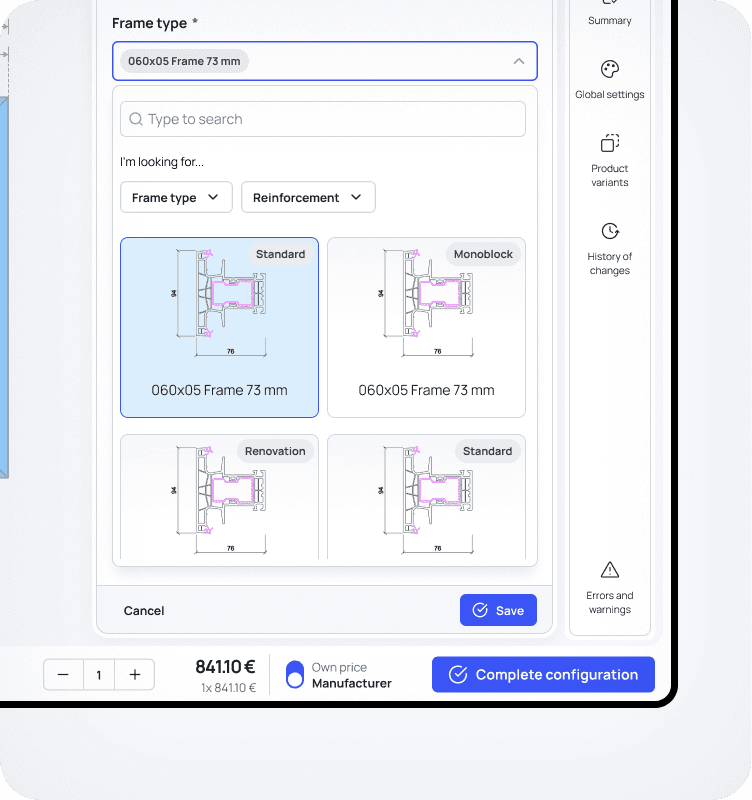
Product configuration means choosing dozens of dependent parameters, where one decision affects the next and directly impacts the final price. Raw production logic had to be simplified into a clear interface process that would be resistant to user error. The challenge was to maintain quoting consistency across a distributed sales network, regardless of the salesperson’s device or location.
Main design challenges:
translating complex product logic into an intuitive configuration flow
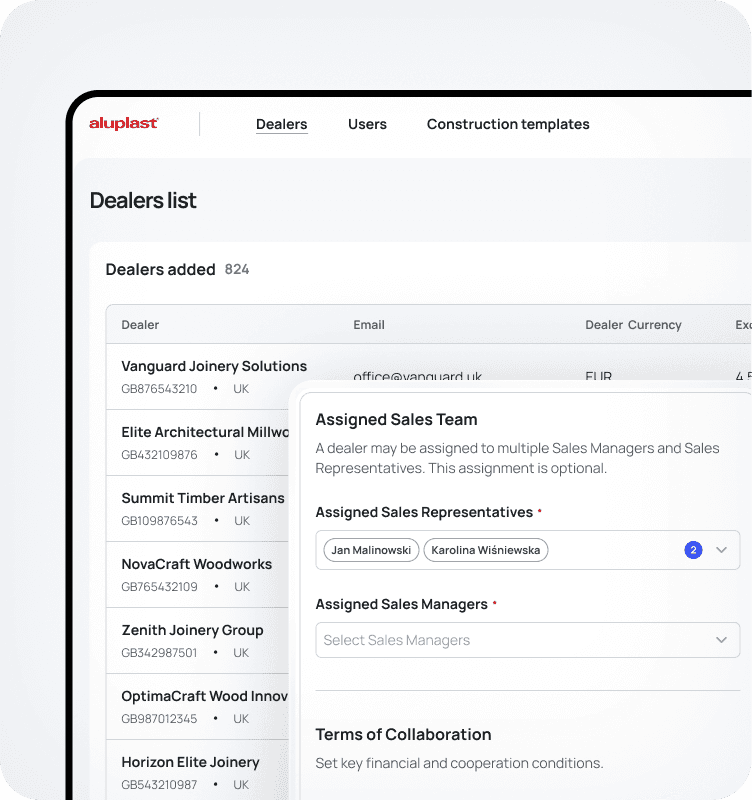
balancing manufacturer control with dealer flexibility
designing a solution scalable across many markets and product variants
building the product foundations in parallel with the design system

Solution
I designed a configurator that simplifies the quoting process for dealers while preserving the manufacturer’s control over technology and offer rules.
Key assumptions:
shorten configuration time without losing accuracy
reduce errors by enforcing product logic
adapt configuration flexibility to different markets
scale the solution across multiple manufacturers and distributors
From the beginning, the system was designed as a solution for many manufacturers and markets, not a single one-off implementation.


AI as support, not a feature
I am responsible for choosing the solution, configuring it, and defining how the agent is fed with knowledge and embedded in the product.
AI does not replace the user or perform actions on their behalf — at least not yet. Currently, it helps users understand the system and make the right decisions. But it is not another chatbot for casual conversation. It is a tool that helps people move through the process without getting stuck.
This is a project where design is not a visual layer, but a tool for solving a real business problem. It connects the needs of the manufacturer, distributor, and end customer in one coherent system.

Key takeaways
The ALUAPP project was a challenge of digitizing technical knowledge and translating it into an efficient sales tool. As the designer responsible for the entire product layer, I focused on creating a bridge between business needs and technological implementation, ensuring that design was not only aesthetic, but above all functional and aligned with the company’s processes.
Most important takeaways:
Design as a shared language: My prototypes and process designs became a platform for jointly defining functionality. This helped the team make business decisions faster and gave analysts a solid foundation for building precise system requirements.
Simplifying complex problems: The greatest value was organizing dozens of technical production rules and enclosing them in a simple mobile interface. As a result, a complex pricing process became accessible to every salesperson, regardless of experience or technical knowledge.
Building for the future: The custom Design System created for ALUAPP is not just a set of components, but a ready-made visual standard for the manufacturer’s future solutions. It gives the product scalability and significantly reduces the time needed to design the next modules of the ecosystem.
Final result
ALUAPP closes the era of waiting for a quote. It moves the sales process from the manufacturer’s desk directly into the hands of the salesperson on site, giving them full independence, technical accuracy, and the speed today’s market expects.
Design system
A design system was developed alongside the product, organizing the interface and enabling its further development. The system was designed with the following in mind:
consistency between views and functions
easy product scalability
support for multiple markets and configuration options
accelerating the development team's workflow
This is not just a set of components, but the foundation for the development of the entire product.
Typography and colors
Manrope is a modern, clean sans serif font that is readable at any size, which is important for RWD designs

Sample component

Variables
The variables consist of Primitive and Semantic Tokens. They concern, among others: colors, typography, rounding, distance, padding, size (e.g. icons) and many others. I also built the RWD layout, as well as Light and Dark mode, using variables.

